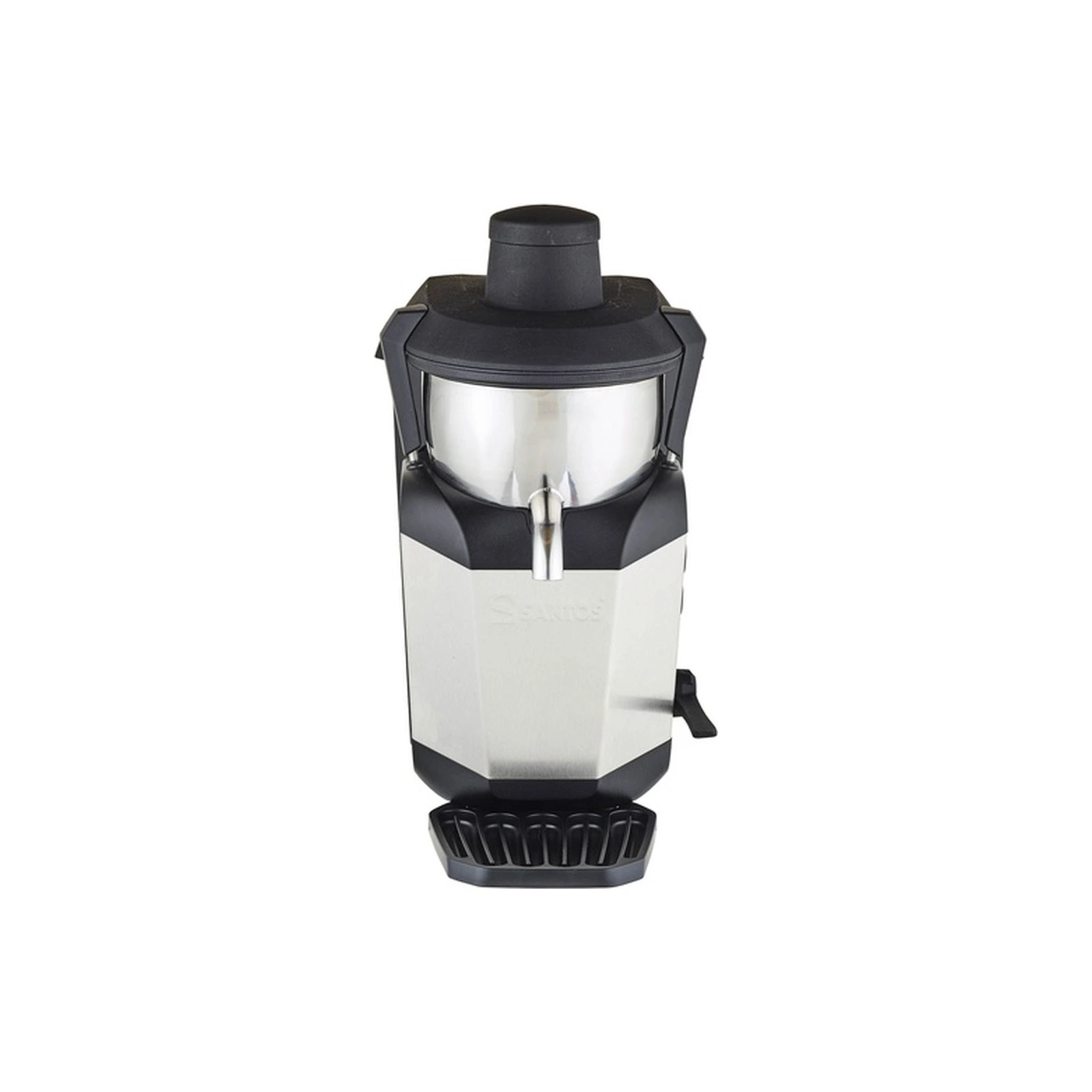
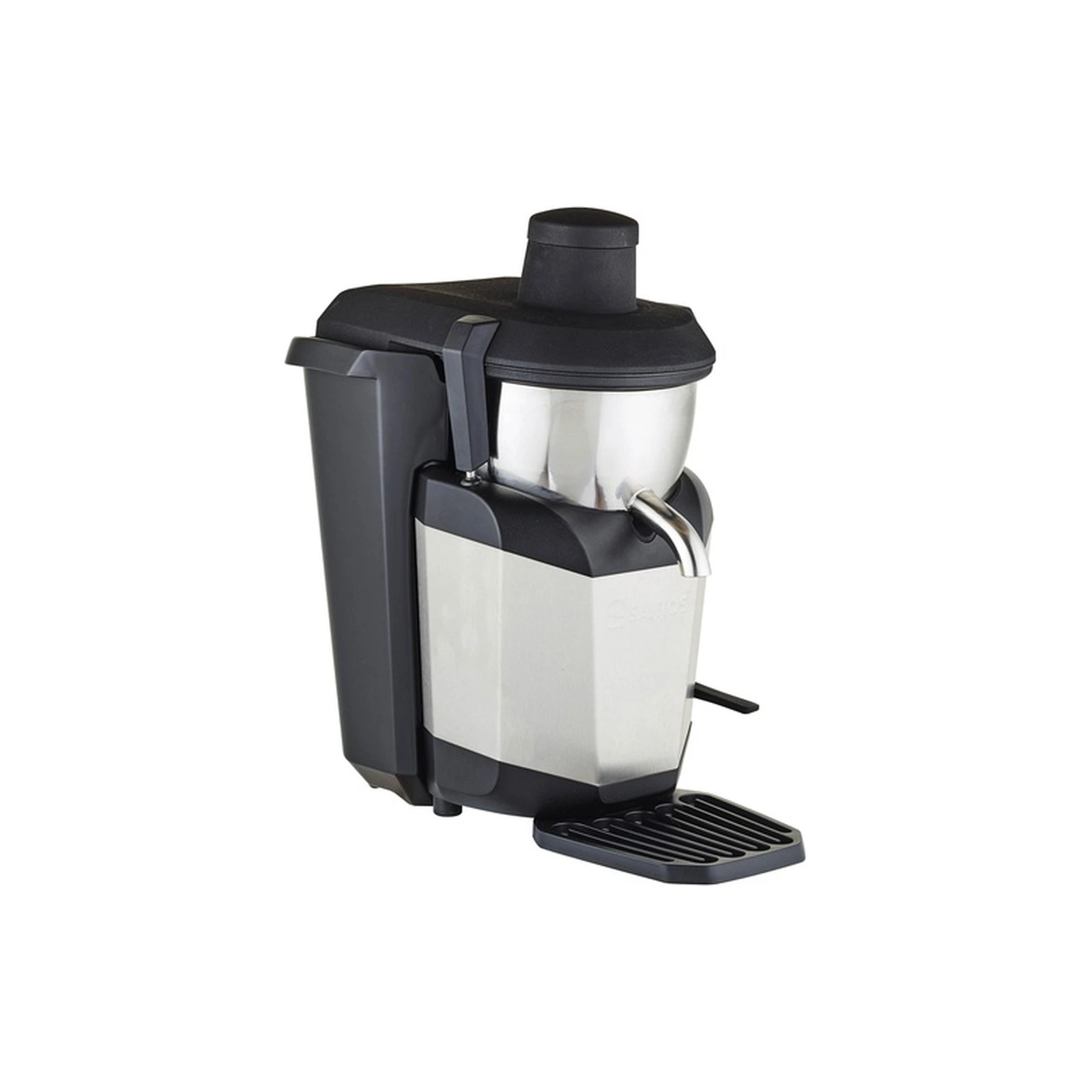
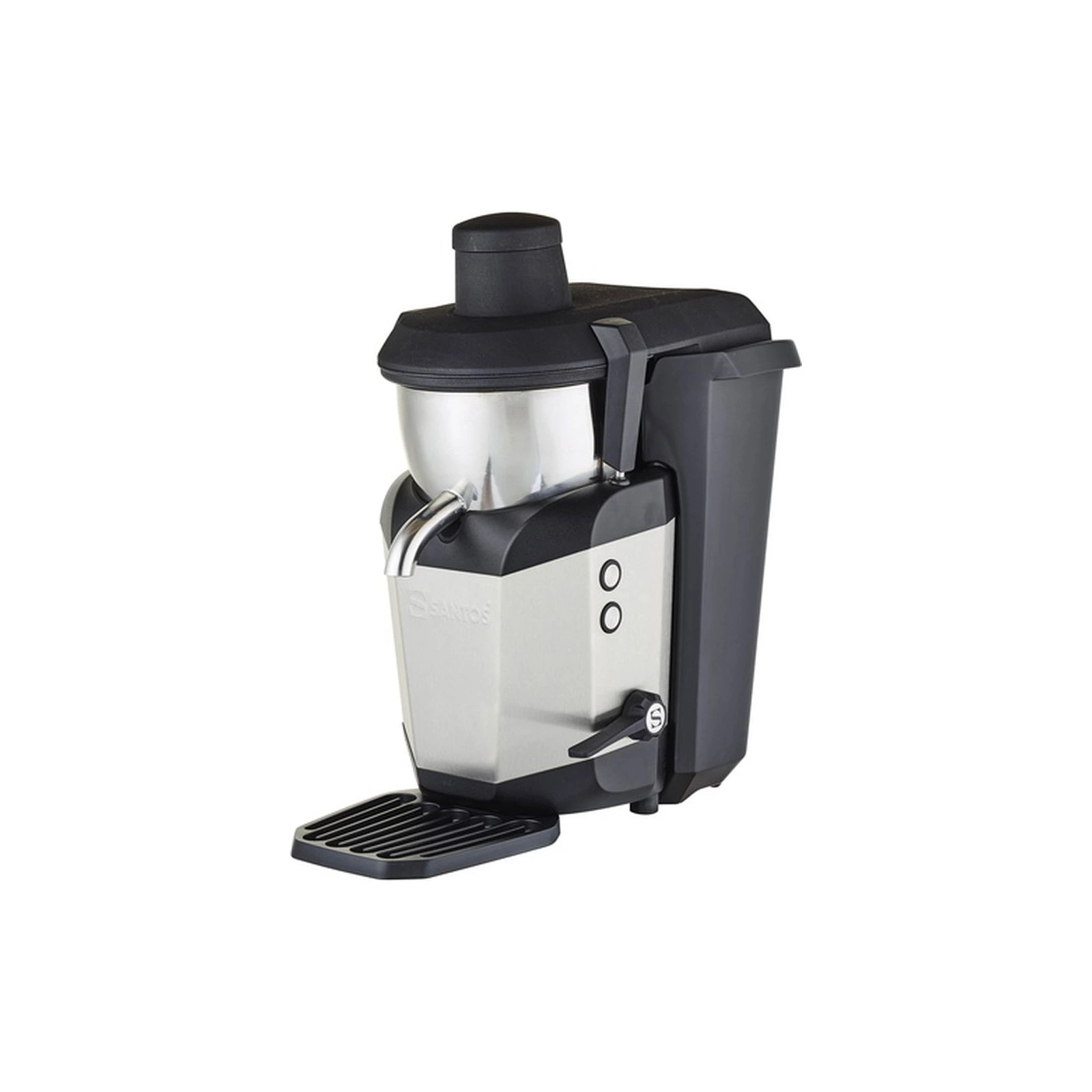
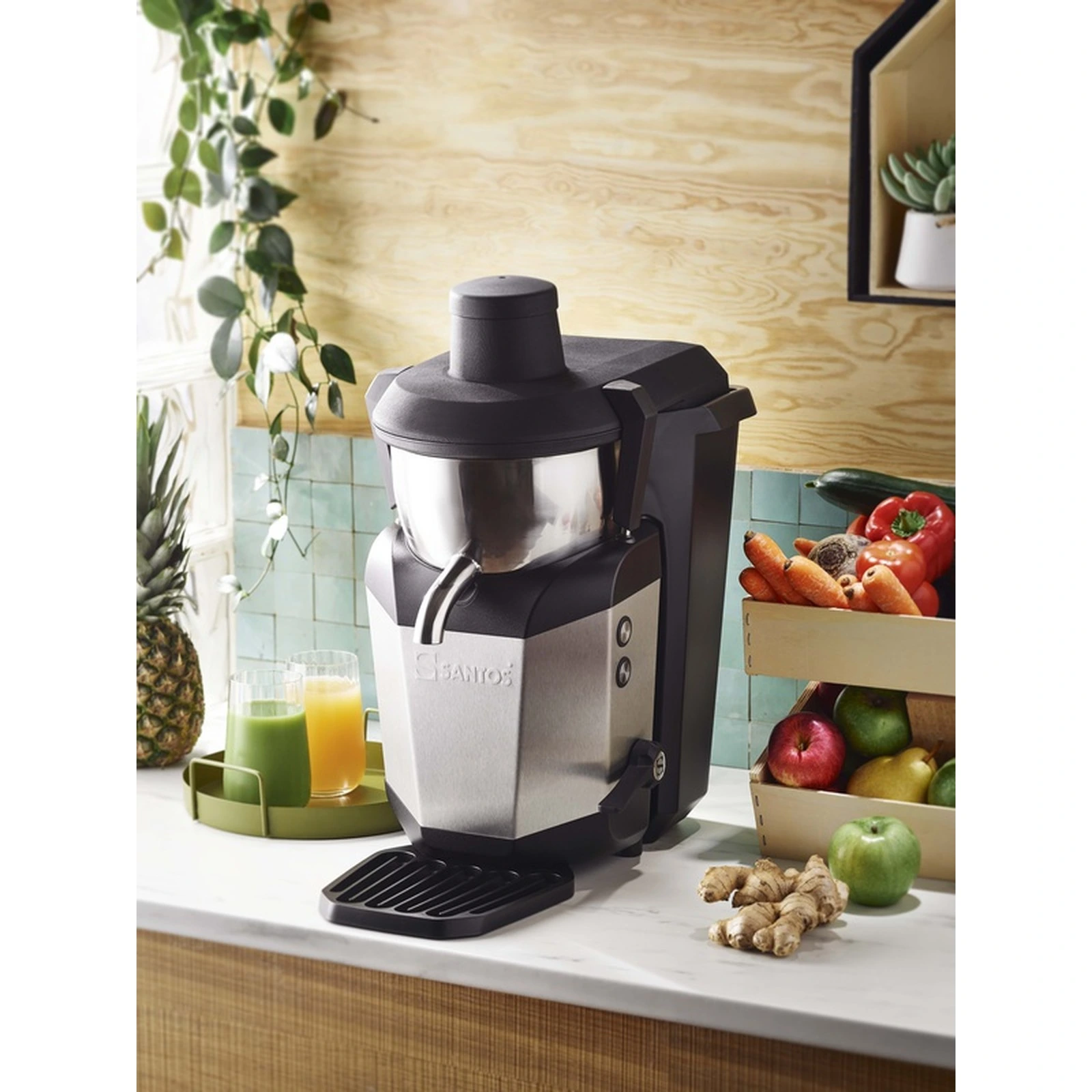
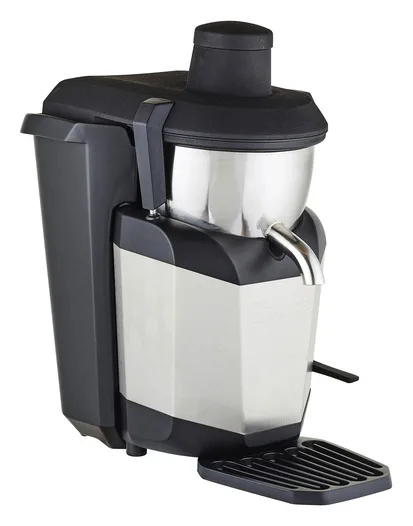
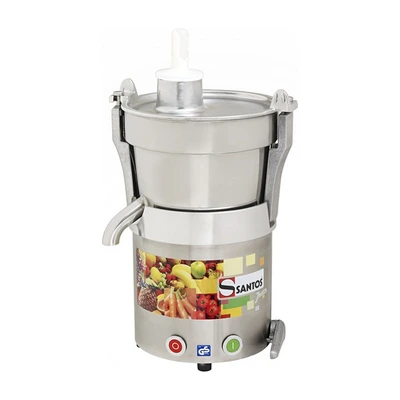
Centrifugal juicer, up to 140 L/h
The „Santos“ #50 is a compact centrifugal juicer for all kinds of fruit and vegetable juice, from apple and carrot to ginger, beetroot and cucumber. It produces up to 140 L of juice an hour and has an 800 W motor.
The juicer is designed for bars, juice bars, restaurants, hotels, and organic and health food shops. Its powerful asynchronous motor runs quietly, at 65 dB(A), so according to „Santos“ the juicer can be used in front of customers.
The manufacturer's manual also mentions restaurant, pizzeria and snack bar kitchens, where the juicer can make juice for drinks and sauces as well as fruit or vegetable coulis. „Santos“ launched the first #50 in 2001 and describes it as the world's first juicer with an XL feed chute. The current #50 came out in 2025, and the manufacturer says this compact model draws on more than 70 years of experience in juice extraction.
Feed chute, basket and spout
The wide XL feed chute (Ø 79.5 mm) takes whole fruit and vegetables, so there is no need to cut them up first, and pushing the produce down takes little effort. Remove the stones from mangoes, apricots, peaches and other stone fruit before juicing — stones must not go through the juicer.
The rotating grater shreds the fruit or vegetables, centrifugal force spins the juice out through the holes in the basket, and a deflector on top of the bowl improves the juice flow. According to „Santos“, the patented auto-clean basket ejects pulp efficiently and improves the juice yield, while its tall, wide shape gives better filtration. The filtering part of the basket is stainless steel; the lower part, which drives and locks the basket, is food-grade engineering plastic.
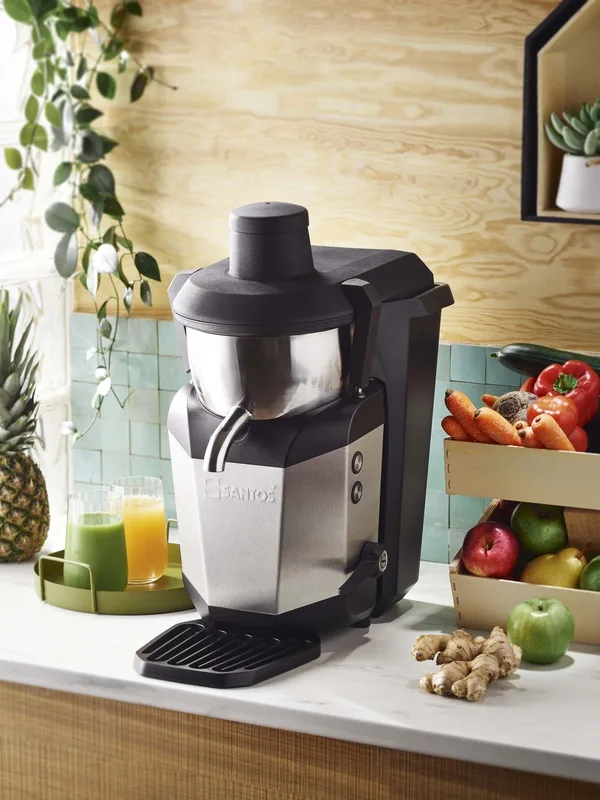
The juice runs into a pressed stainless steel bowl and out through a stainless steel spout. The spout height is 210 mm, so according to „Santos“ you can juice straight into glasses, jars or blender jugs. A removable drip tray sits under the spout. Materials in contact with food comply with Regulations (EC) No 1935/2004 and (EU) No 10/2011.
Pulp container and locking
Pulp leaves through an outlet in the lid and goes into a 10 L pulp container behind the bowl. The Ezy-fit™ container locates on a centring pin, so the container is easy to position correctly and securely. You can juice roughly 12.5 kg of apples or 7.5 kg of carrots before the container is full.
The Ezy-lock™ system locks the lid and bowl in a single movement: turning the locking handle 180° towards the front makes the locking rods clamp the lid and bowl against the motor unit. With the Ezy-clean™ system, the bowl, basket and lid come off without tools, so the juicer is quick and easy to clean.
Using the juicer
Before first use, wash all parts that come into contact with food in clean water. To assemble, fit the bowl on its seat with the spout in the notch at the front, place the deflector on top of the bowl and lower the basket into the bowl — the basket settles into place under its own weight, but check its position. Then locate the pulp container on the centring pin behind the bowl, fit the lid so that its pulp outlet lines up with the container inlet, and turn the locking handle 180° towards the front.
Plug in, switch the juicer on with the On button and place a glass or jug under the spout. Only then feed fruit or vegetables into the chute, pushing them onto the rotating grater with the pusher. Always use the pusher supplied with the juicer: feeding food in by hand or with any other utensil can be dangerous.
Keep an eye on the pulp level: if the container overfills, pulp blocks the outlet in the lid, the basket becomes unbalanced and the juicer may be damaged. If an imbalance appears well before the container is full, carrying on juicing sometimes helps; if the imbalance does not go away, stop the juicer and clean the basket. Some produce builds up and clogs the holes in the basket, which then needs cleaning more often.
You can combine produce — for example, juice carrots and then apples for an apple and carrot juice. To switch from one juice to another without taking the juicer apart, put a fresh glass or jug under the spout and pour a little water into the chute while the basket is spinning. „Santos“ says this quick rinse is only for exceptional cases, when small quantities of different juices are made glass by glass.
To stop the juicer, press the Off button, turn the locking handle 180° towards the back or pull out the plug.
Duty cycle and safety
The juicer is designed for intermittent use: 2 minutes on, 4 minutes off (EN 60335-2-64) — the running time to make the juice and the pause to prepare and serve it. The juicer is not intended for frozen food or for continuous mass production, and must not be left running unattended.
The juicer starts only when the lid and bowl are correctly seated on the motor unit and the locking handle is in the closed, locked position. Loosening the handle cuts the power, and a friction brake stops the basket in under 2 seconds. To restart, press the On button again. The juicer also stops if the mains supply fails.
The motor has a built-in thermal cut-out and overload protection, and the juicer stops automatically if the motor overheats — the metal casing around the motor unit will be hot. Press the Off button, unplug the juicer and let the motor cool for 15–30 minutes before switching on again. If this keeps happening, unplug the juicer and call a service engineer or an authorised „Santos“ dealer.
The On/Off buttons have overload and no-volt release protection, all mechanical parts are earthed and every juicer is tested at the factory after assembly.
Cleaning and care
Switch the juicer off and unplug it before cleaning. The bowl, deflector, basket, lid and pusher are easiest to clean straight after use, before food dries on them.
Wash the basket, bowl, deflector, lid, pulp container, pusher and bowl seat in clean water or with washing-up liquid, then rinse and dry them; the manufacturer's leaflet adds that all removable parts are dishwasher-safe. A non-abrasive brush is best for the holes in the basket and the grater teeth. Never use abrasive sponges, cleaners or cloths on the basket, and handle it with care so that it keeps its shape: a distorted basket stops the juicer working properly.
Wipe the base and casing of the motor unit with a soft damp sponge and dry them. Never immerse the base in water, and do not clean the juicer with a water jet, pressure washer or steam cleaner.
The bearings are lubricated for life, so no routine maintenance is needed. The manufacturer classes the grater and basket as wear parts, along with electrical components such as the starting capacitor, starting relay and power relay. If the juicer vibrates when running empty, check that the basket is fitted correctly; a distorted basket or a worn plastic lower part of the basket can also cause vibration, and the damaged part should then be replaced. After a long period out of use, clean the juicer and check the power cord, seals and other parts before using it again.
Spare parts are ordered by the manufacturer's part numbers: auto-clean basket — 50205, pusher — 50106, drip tray — 50956. Part numbers for everything else are in the spare parts diagram on the ‘Technical Data Sheet’ tab. When ordering, give the model, serial number and electrical data from the rating plate on the underside of the juicer. Use only genuine „Santos“ spare parts.
Dimensions and electrical connection
The juicer is 290 mm wide, 530 mm deep and 515 mm high, and weighs 15.1 kg. One person can move it, but never lift the juicer by the lid or the locking rods, including when unpacking.
Place the juicer on a table or worktop with the spout facing you, which leaves the pulp container at the back; the manufacturer recommends a working height of about 90 cm, adjusted to suit the user. If the counter is too shallow, the juicer can be turned so that the spout points left and the On and Off buttons face the front; the pulp container is then on the right. The surface must not slope more than 10°, and all four feet must rest on it. Do not use the juicer outdoors or place it on or near a source of heat.
The 800 W juicer connects to a single-phase 220–240 V supply and runs on 50 Hz or 60 Hz without any adjustment. The juicer plugs into a standard earthed socket (2-pole + earth), so no hard-wiring is needed; the circuit must be protected by a residual current device (RCD) and a 16 A fuse. Do not plug other appliances into the same socket. Never use the juicer with a damaged power cord — the cord must be replaced by an authorised „Santos“ dealer or a similarly qualified person.
Technical specifications
| Manufacturer | „Santos“ |
|---|
| Model | #50 |
|---|
| Manufacturer code | 50 |
|---|
| Output | up to 140 L/h |
|---|
| Feed chute | Ø 79.5 mm (XL), takes whole fruit and vegetables |
|---|
| Basket | patented auto-clean, stainless steel with a food-grade engineering plastic lower part |
|---|
| Bowl | pressed stainless steel, with a stainless steel spout |
|---|
| Spout height | 210 mm |
|---|
| Pulp container | 10 L, located on a centring pin (Ezy-fit™) |
|---|
| Lid locking | Ezy-lock™ — one handle locks the lid and bowl together |
|---|
| Safety | the juicer will not start unless the lid and bowl are locked; loosening the handle cuts the power and a brake stops the basket in under 2 s |
|---|
| Controls | On and Off buttons |
|---|
| Motor | single-phase asynchronous, with a thermal cut-out and overload protection |
|---|
| Power | 800 W |
|---|
| Power supply | 220–240 V, single-phase, 50/60 Hz |
|---|
| Speed | 3,000 rpm (50 Hz), 3,600 rpm (60 Hz) |
|---|
| Power cord | with a plug for an earthed socket |
|---|
| Duty cycle | intermittent: 2 minutes on, 4 minutes off |
|---|
| Noise level | 65 dB(A) at 1 m |
|---|
| Materials | cast aluminium, engineering plastic, stainless steel sheet |
|---|
| Cleaning | bowl, basket and lid come off without tools (Ezy-clean™); removable parts are dishwasher-safe |
|---|
| Dimensions (W × D × H) | 290 × 530 × 515 mm |
|---|
| Net weight | 15.1 kg |
|---|
| Gross weight | 16.3 kg |
|---|
| Package dimensions (W × D × H) | 324 × 484 × 580 mm |
|---|
| Spare parts | auto-clean basket (50205), pusher (50106), drip tray (50956) |
|---|
| Compliance | CE, RoHS |
|---|
| Country of origin | France |
|---|