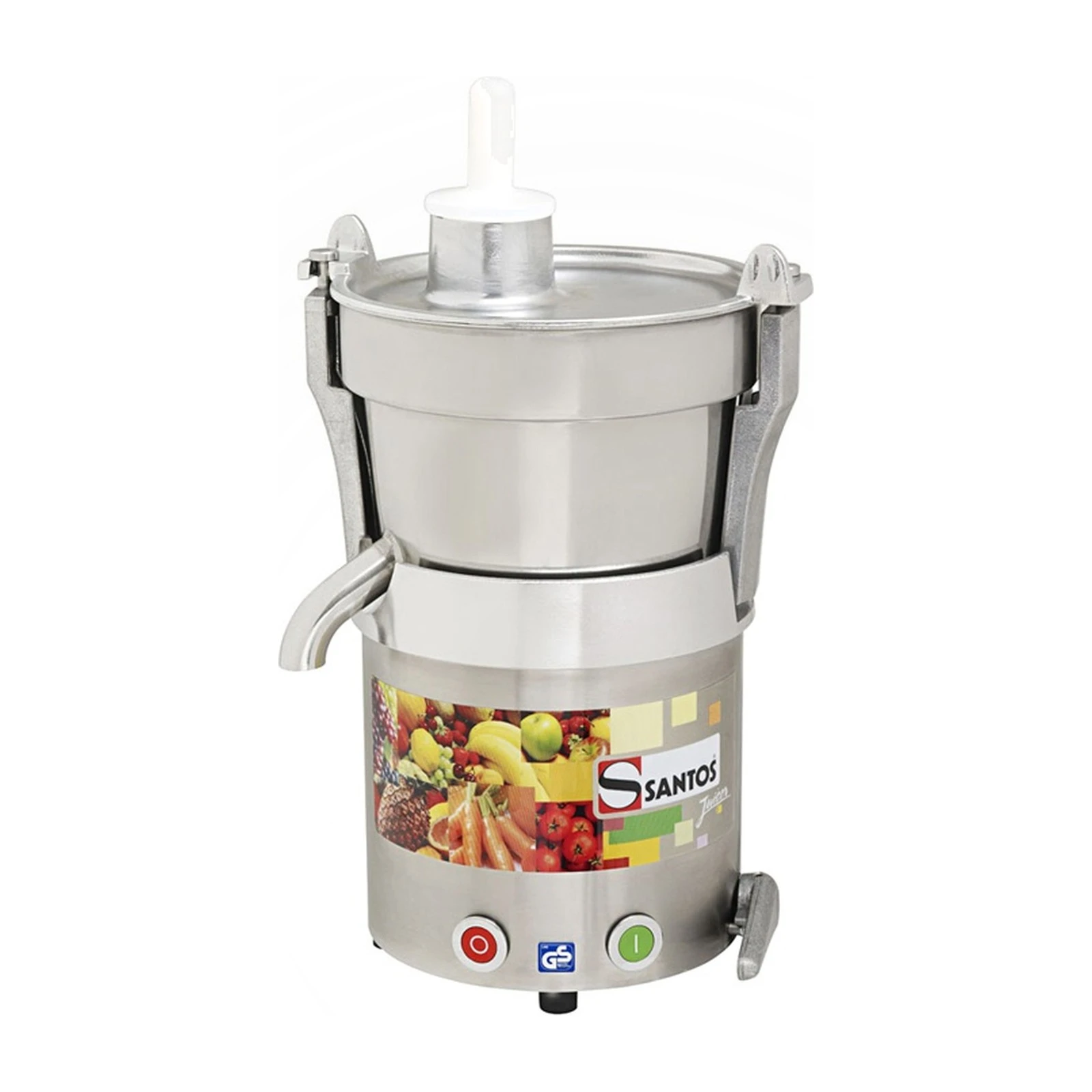
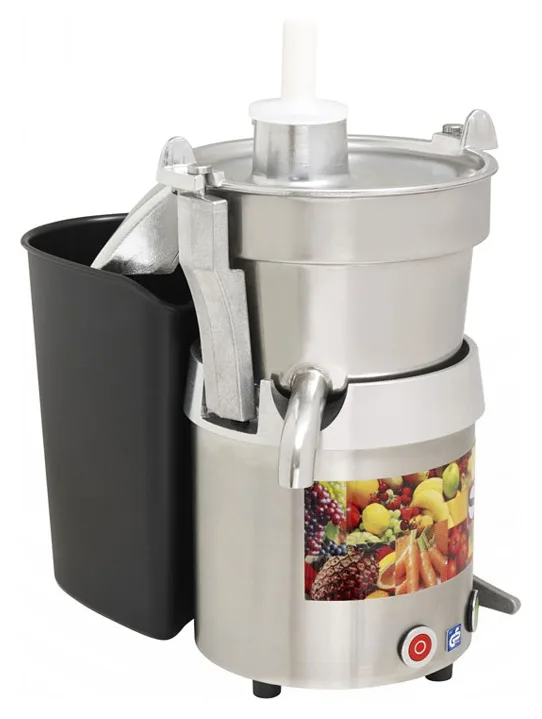
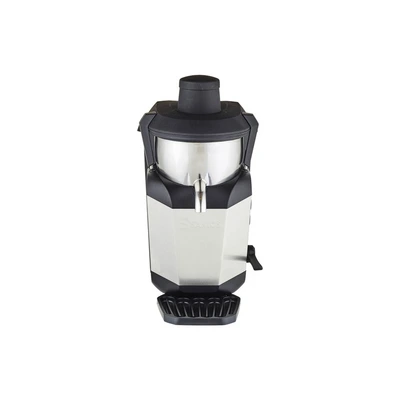
Centrifugal juicer, 100 L/h
The „Santos“ #28 is a classic centrifugal juicer that „Santos“ has been making since 1986. It makes all kinds of fruit and vegetable juice, from apple and carrot to ginger, beetroot and cucumber. Output is 100 L an hour and the motor is rated at 1,300 W.
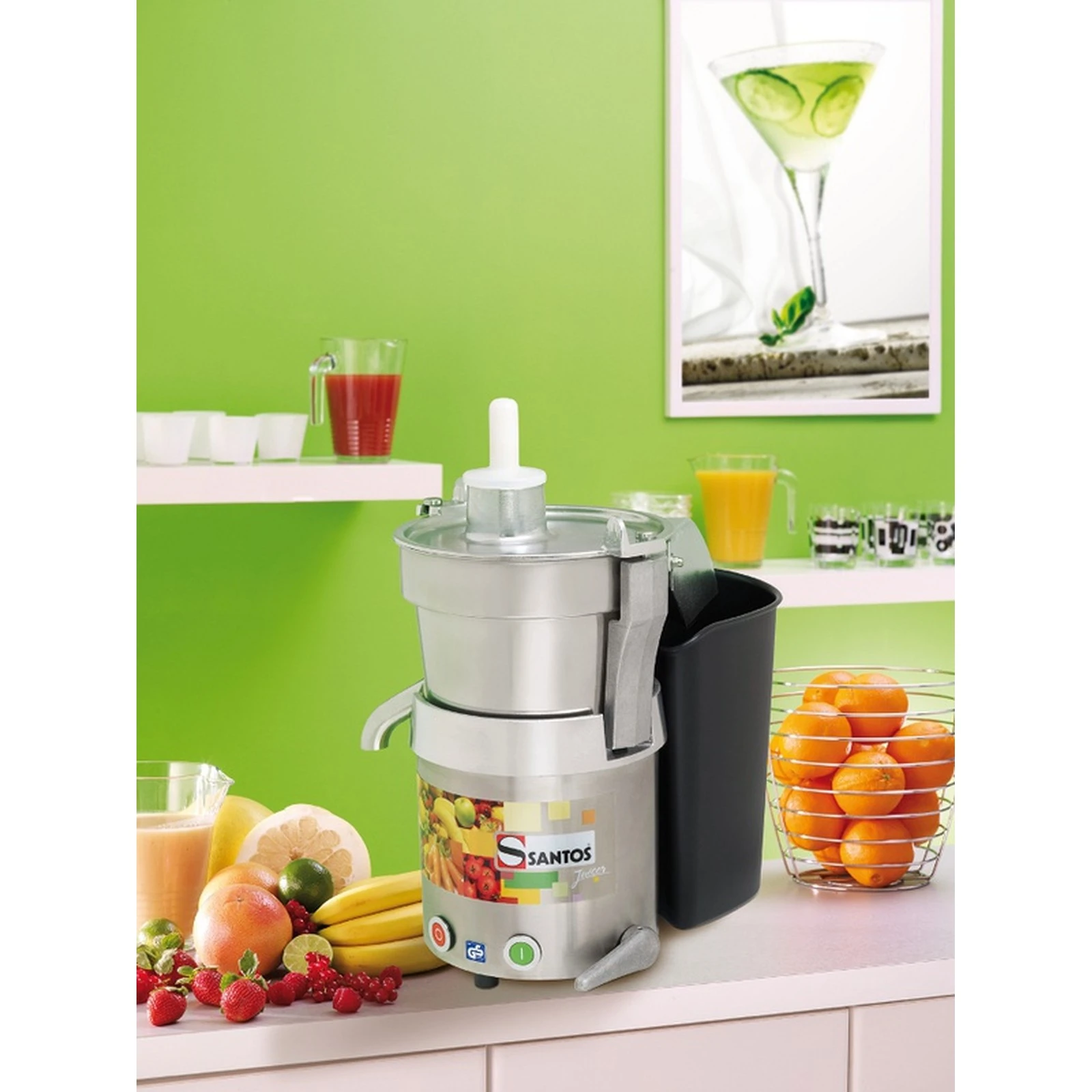
The juicer is designed for juice bars, restaurants, hotels and health food shops. „Santos“ describes it as quiet, powerful and sturdy, with an asynchronous motor adapted to intensive use and an excellent juice yield.
The manufacturer's manual also mentions restaurant, pizzeria and snack bar kitchens, where the juicer can make juice for drinks and sauces as well as fruit or vegetable coulis.
Feed chute, basket and spout
The aluminium lid has a large feed chute (Ø 68 mm), and according to „Santos“ pushing the produce down takes little effort. Remove the stones from mangoes, apricots, peaches and similar fruit before juicing — stones must not go through the juicer.
The rotating grater shreds the fruit or vegetables, and centrifugal force spins the juice out through the holes in the basket. According to „Santos“, the large basket with its very fine holes (0.5 mm) filters the juice well. The filtering part of the basket is stainless steel. The basket is held by a screw, which is tightened and undone with a special key supplied with the juicer.
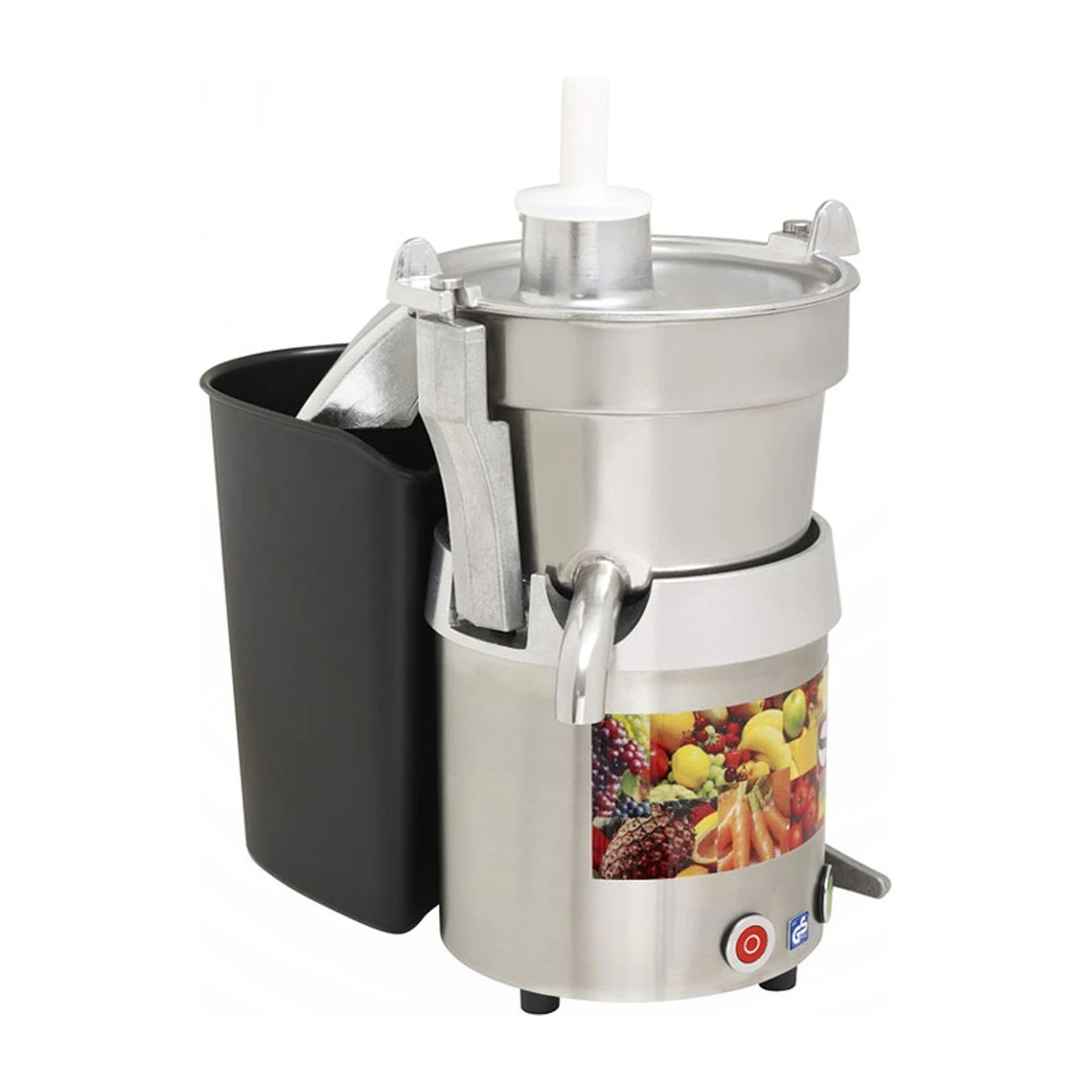
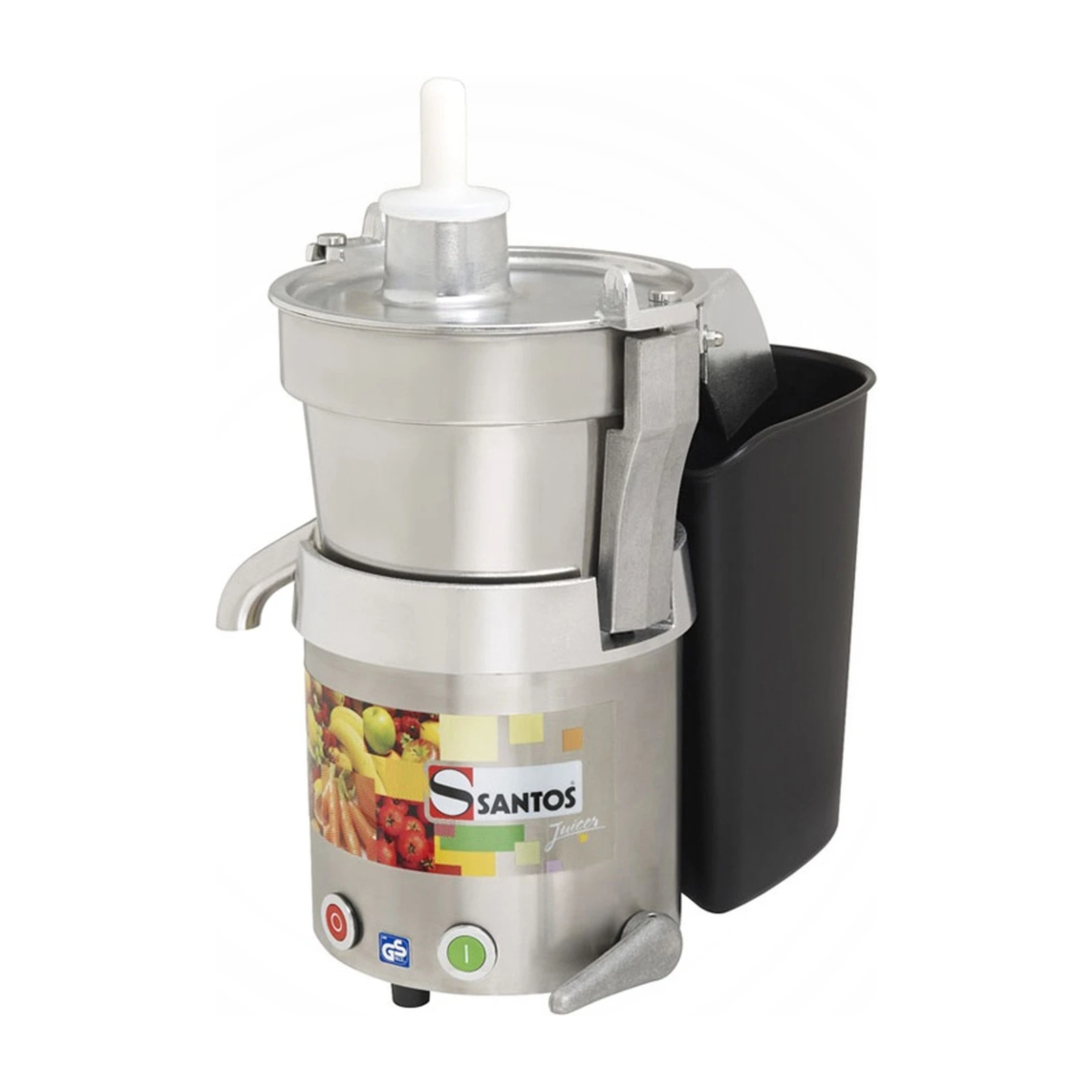
The juice runs into a removable bowl of pressed 18/10 stainless steel and out through a stainless steel spout. The spout is 222 mm high, so you can juice straight into a glass or jug, and there is room under the spout for blender jugs too. The body of the juicer is stainless steel and aluminium. Materials in contact with food comply with Regulations (EC) No 1935/2004 and (EU) No 10/2011.
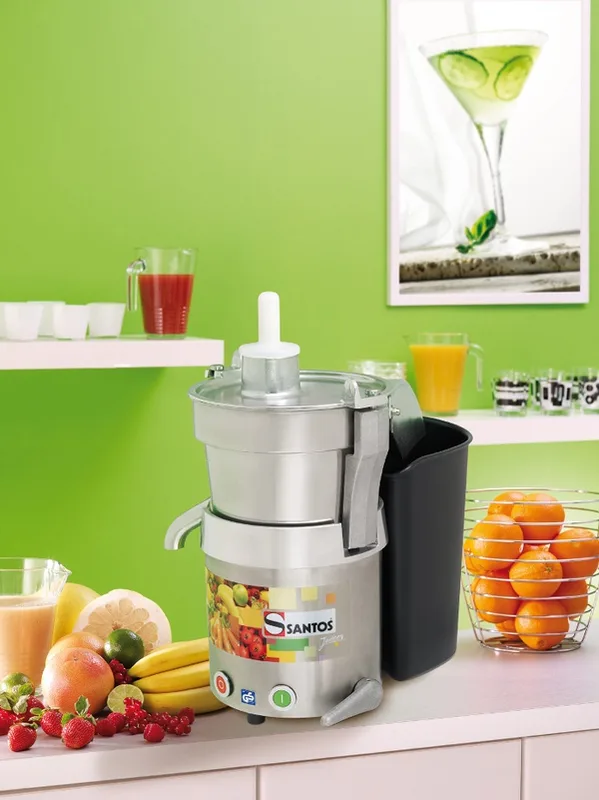
Pulp container and locking
Pulp is ejected automatically: it leaves through the outlet in the lid and runs down the pulp chute into a 7.5 L pulp container. How much produce you can juice before the container is full depends on what you are processing.
A sturdy locking system holds the lid in place: two lugs on the lid hook onto catches on the locking rods, and half a turn of the locking handle clamps the lid shut.
Using the juicer
Before first use, take the juicer apart. Remove the pusher, give the locking handle half a turn to release the lid, then turn the lid and lift it off. Holding the basket still with one hand, undo the basket screw completely with the key and lift the bowl — the basket lifts out with it. Wash the basket in clean water, and the pusher, lid, bowl and pulp container in soapy water. Then fit the pulp chute: place it on the bowl and tighten the two nuts onto the bowl studs.
To assemble, fit the bowl on its seat with the spout in the notch provided, then place the basket in the bowl so that the basket sits correctly on the motor shaft, with the drive pin in the grooves of the basket. Insert the basket screw and tighten it with the key; the basket drops a few millimetres as you do so, and you can hold it with one hand. Fit the lid and turn it until its lugs engage the locking rods, then give the locking handle half a turn. Put the pusher in the feed chute, line up the pulp container with the outlet of the pulp chute, plug the juicer in and take the pusher out again.
Switch the juicer on with the On button and place a glass or jug under the spout. Only then feed fruit or vegetables into the chute, pushing them onto the rotating grater with the pusher.
Keep an eye on the pulp level: if the container overfills, pulp blocks the outlet in the lid, the basket becomes unbalanced and the juicer may be damaged. If an imbalance appears well before the container is full, carrying on juicing sometimes clears it; if the imbalance persists, stop the juicer and clean the basket. Some produce tends to clog the holes in the basket, which then needs cleaning more often.
To stop the juicer, press the Off button, turn the locking handle from the front to the back or pull out the plug.
Duty cycle and safety
The juicer is designed for intermittent use: 2 minutes on, 4 minutes off. It is not intended for frozen food or for continuous mass production, and must not be left running unattended.
The juicer starts only when the bowl and lid are correctly in place on the bowl seat and held by the locking handle. Loosening the handle cuts the power, and a friction brake stops the basket in under 3 seconds. To restart, press the On button again. The juicer also stops if the mains supply fails.
If the motor jams because of a foreign object, produce that is too hard or too much pressure on the pusher, a circuit breaker on the underside of the juicer trips and cuts the power to the motor. Clear the cause, reset the circuit breaker and restart the juicer. If the problem persists, unplug the juicer and call a service engineer or an approved „Santos“ dealer.
If the juicer will not start, check that power is reaching it and that the power cord is undamaged, and make sure the bowl is correctly on its seat, the lid is on the bowl and the locking handle is locked.
The On/Off buttons have overload and no-volt release protection, all mechanical parts are earthed and every juicer is tested at the factory after assembly.
Cleaning and care
Switch the juicer off and unplug it before cleaning. The bowl, basket, lid and pusher are easiest to clean straight after use, before food dries on them. Take the basket out as you did before first use: release and lift off the lid, undo the basket screw with the key and lift the bowl.
Wash the basket, bowl, lid, pulp container and pusher in clean water or with washing-up liquid, then rinse and dry them; the manufacturer's leaflet adds that all removable parts are dishwasher-safe. The brush supplied with the juicer is best for the holes in the basket and the grater teeth. Never use abrasive sponges, cleaners or cloths on the basket, and handle it with care so that it keeps its shape: a distorted basket stops the juicer working properly.
Wipe the base with a soft damp sponge and dry it. Never immerse the base in water, and do not clean the juicer with a water jet or pressure washer.
The bearings are lubricated for life, so no routine maintenance is needed. The manufacturer classes the grater, the basket and electrical components as wear parts. If the juicer vibrates when running empty, check that the basket is fitted correctly; a distorted basket can also cause vibration and must then be replaced. After a long period out of use, clean the juicer and check the power cord, seals and other parts before using it again.
Spare parts are ordered by the manufacturer's part numbers: basket with 0.5 mm holes (as supplied with the juicer) — 28200, basket with 0.8 mm holes for fibrous produce such as pineapple or ginger — 28200B, start relay — 28505. Part numbers for everything else are in the spare parts diagram on the ‘Technical Data Sheet’ tab. When ordering, give the model, serial number and electrical data from the rating plate on the underside of the juicer. Use only genuine „Santos“ spare parts.
Dimensions and electrical connection
The juicer is 320 mm wide, 480 mm deep and 570 mm high, and weighs 23.65 kg. One person can move it, but never hold or lift the juicer by the locking handle, including when unpacking.
Place the juicer on a table or worktop with the spout and the On and Off buttons facing you; the manufacturer recommends a working height of about 90 cm, adjusted to suit the user. The surface must not slope more than 10°, all four feet must rest on it and the motor shaft must be perpendicular to it. Take care: the floor next to the juicer may be slippery. Do not use the juicer outdoors or place it on or near a source of heat.
The 1,300 W juicer draws 7 A and connects to a single-phase 220–240 V, 50/60 Hz supply. It plugs into a standard earthed socket (2-pole + earth), so no hard-wiring is needed; the circuit must be protected by a residual current device (RCD) and a 16 A fuse. Before plugging in, check that the mains voltage matches the voltage on the rating plate, and keep the plug within easy reach while the juicer is in use. An equipotential bonding terminal is fitted on the underside. Do not plug other appliances into the same socket. Never use the juicer with a damaged power cord — the cord must be replaced by an approved „Santos“ dealer, by „Santos“ itself or by a similarly qualified person.
Technical specifications
| Manufacturer | „Santos“ |
|---|
| Model | #28 |
|---|
| Manufacturer code | 28 |
|---|
| Output | 100 L/h |
|---|
| Feed chute | Ø 68 mm, in the aluminium lid |
|---|
| Basket | removable, with a stainless steel filtering part and 0.5 mm holes; held by a screw that is tightened with the special key supplied |
|---|
| Bowl | removable, pressed 18/10 stainless steel, with a stainless steel spout |
|---|
| Spout height | 222 mm |
|---|
| Pulp container | 7.5 L; pulp is ejected into it automatically |
|---|
| Lid locking | the lid hooks onto the locking rods and is clamped shut by half a turn of the locking handle |
|---|
| Safety | the juicer will not start unless the bowl and lid are locked; loosening the handle cuts the power and a brake stops the basket in under 3 s |
|---|
| Controls | On and Off buttons |
|---|
| Motor | single-phase asynchronous, with overload protection (8 A circuit breaker on the underside) |
|---|
| Power | 1,300 W |
|---|
| Power supply | 220–240 V, single-phase, 50/60 Hz |
|---|
| Speed | 3,000 rpm (50 Hz), 3,600 rpm (60 Hz) |
|---|
| Power cord | with a plug for an earthed socket |
|---|
| Duty cycle | intermittent: 2 minutes on, 4 minutes off |
|---|
| Noise level | 75 dB(A), measured at 3,000 rpm |
|---|
| Materials | cast aluminium, engineering plastic, 18/10 stainless steel sheet; stainless steel and aluminium body |
|---|
| Cleaning | bowl and basket come out (the basket screw is undone with the key); removable parts are dishwasher-safe; a basket cleaning brush is supplied |
|---|
| Dimensions (W × D × H) | 320 × 480 × 570 mm |
|---|
| Net weight | 23.65 kg |
|---|
| Gross weight | 26.4 kg |
|---|
| Package dimensions (W × D × H) | 370 × 660 × 590 mm |
|---|
| Spare parts | basket with 0.5 mm holes (28200), basket with 0.8 mm holes for fibrous produce (28200B), start relay (28505) |
|---|
| Compliance | CE, KC, RoHS |
|---|
| Country of origin | France |
|---|